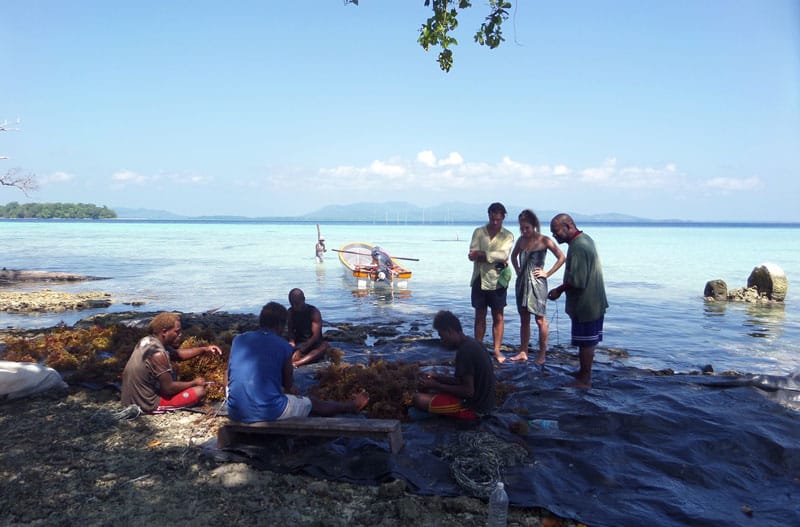
Meet Uncle Henry. Henry is from Malaita province, chews bettlenut (literally all day) refuses to wear shoes and is one of the most brilliant people you’ll ever meet.
Henry has built from scratch four highly successful seaweed farms across the Malaita, West and Central provinces.
He believes education is the currency of local Solomon villages and that by developing farms across Solomons he can give people an opportunity to learn skills, build self-esteem and create income streams for local villages.
As part of the leadership program Henry has learnt the importance of having a clear strategy for your business, including a vision, mission and values. He has learnt the importance of writing down systems so that when he can’t visit the farms, people can have a reference point on how to do things. He has learnt the importance of a growth mindset and giving your team a clear sense of progress.
He pays his staff generously. He laughs loudly. He prays regularly. And he gave me one of the most genuine Solomon experiences I’ve had in my three months in Solomons.

There are many rules around gender here, and so it was not appropriate for me to visit the farm ‘unaccompanied’ so my friend Kevin came as my ‘security’. I have been working with Henry for almost 3 months now, but outside of the professional setting, Henry would mainly speak to me via Kevin which was incredibly strange for me to experience.
The boat ride was meant to take 1.5 hours. It took at least 3.5 hours (Solomon time). We went across on a banana boat through open water where we could not see land for hours. The swell was huge, the ride was rough, time took a different course entirely and it was magnificent.
When we arrived we met his 12 boys who are living on the island. He has 24 staff on each farm, rotating on a 2 week roster (2 weeks on, 2 weeks off). They sleep in hammocks, are young, bachelors, quiet, strong and most definitely do not speak English. But they did love a cold solbrew.
They sit by the ocean and weave pieces of seaweed onto small loops on lines of rope, and when the lines are ready, they drive their banana boat out to the ocean where the lines are under water and line them in rows and rows. At the moment this particular farm has 3000 lines! The seaweed is then left to grow nice and big until it’s ready to come back out. The seaweed is then threaded back off the rope and left to dry in the sun for a couple weeks. From here, it’s bagged up and exported all over the world. It’s often used in pharmaceutical products.
So for each seaweed farm Henry establishes, he creates around 30 new jobs for local village people. This may not sound like much to you, but for Solomons it is significant. Unemployment is a massive issue here, and it contributes to a lot of the un-diagnosed and untreated mental health issues in this beautiful country.
On the way home we stopped by a local village to buy some cray fish. We were welcomed onto the island and Henry showed me around. Over here they separate their kitchen and sleeping quarters, with each having its own designated leaf hut. They cook whatever they can catch and grow on hot stones (motu). There are pigs and chickens just roaming around. There is no question about whether they eat free range and organic over here. The people are dirty, poor, shy, curious and beautiful and they admire Henry for the jobs he is creating for their villages.
When we finally got back to Honiara, well about an hour away, it was dark and we hit the reef because we couldn’t see. So we paddled into shore and a local village welcomed us inside and shared their remains of dinner with us. Beautiful slippery cabbage, fresh grilled fish and rice. No cost. It’s just what they do. We sat around for another 2 hours and told stories until a bus was arranged to drive us back into town. Two of the men stayed with the boat for the night to drive it back to town the next morning. We ended up getting home at 10.30pm at night. It was a typical Solomon day, and I feel so privileged to have been able to experience it, it was simply perfect.
This is only one of the amazing Leaders I have had the privilege to work with. And one by one, these leaders will slowly change the course of Solomon Islands.