

Spheres of Control, Influence and the Brutal Facts
In his book Good to Great, business researcher Jim Collins introduced the concept of “the brutal facts.” Unpleasant but undeniable truths that must be faced if meaningful progress is to occur. Effective leaders don’t ignore these facts, nor do they allow them to become excuses. Instead, they acknowledge reality and act intentionally within their sphere of control and influence. This is the essence of an internal locus of control. It’s not about pretending you control everything, it’s about recognising where your power lies and choosing how to respond. To develop accountability effectively in leadership, we must first get very clear on what this looks like for us.
Here is a 3.5-minute explainer video on this concept:

The Three Spheres
Take a look at the image on the right. The white inner circle represents your Sphere of Control. This includes the things you can control completely: your thoughts, emotions, and responses. These are at the core of an internal locus of control.
The orange middle circle depicts your Sphere of Influence. These are the people, situations, and processes you can’t fully control but can still influence through your behaviour, communication, or choices.
The white outer space symbolises the Brutal Facts. These are the external realities that lie entirely outside your control, such as organisational changes, market conditions, or—and this one often trips us up—other people’s actions.
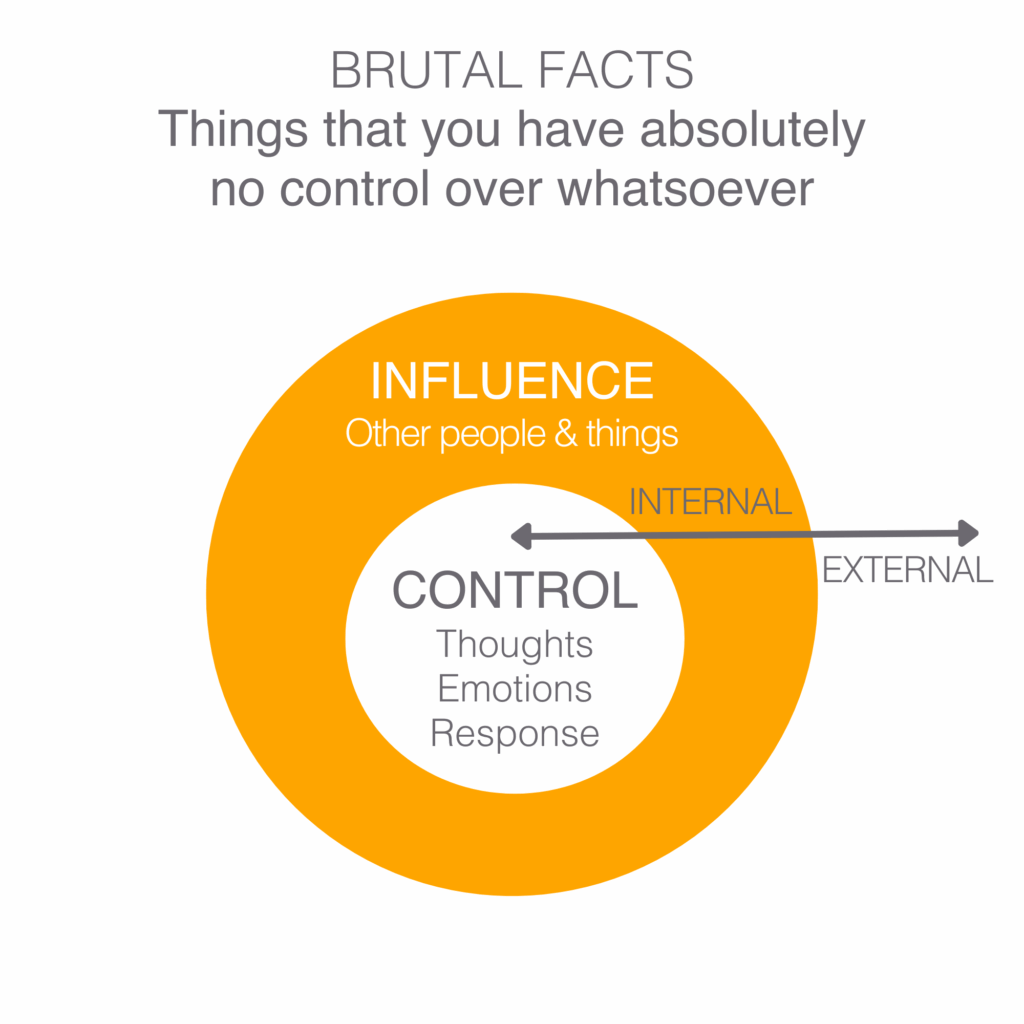
Let’s take a moment to explore how the locus of control continuum interacts with the Spheres of Life model, and how this plays out in real-world thinking and behaviour.
Someone with an external locus of control tends to operate from the outside looking in, which is why that end of the continuum sits in the outermost sphere. They feel that life happens to them, and outcomes are determined by luck, fate, or those brutal facts. They attribute both success and failure to forces outside themselves—other people, systems, or circumstances. As a result, they often believe they have little or no power to influence what happens around them. This sense of powerlessness can even extend to their inner world, or sphere of control. Because they believe their environment dictates how they feel, they can’t recognise they have a choice in how they think, feel, or respond. In the passenger mindset, the outer two spheres are seen as controlling the inner sphere.
Now let’s flip this script.
Someone with an internal locus of control sees the model from the inside out. They accept that while they cannot control the brutal facts, they always have a choice over how they think, feel and respond and that this can influence the people and circumstances around them. This doesn’t mean they control everything, it means they take ownership of their role in shaping outcomes, regardless of the external context.
Choosing an internal Locus of Control, means we are clear on the Spheres of Life: What we can control, what we may influence and what we must accept.
Applying the Spheres of Life
Imagine your organisation has recently undergone a change in senior leadership. As a result, the project you’ve been leading is now facing unexpected and significant changes due to the new leader’s direction. This situation can feel frustrating or disempowering but using the Spheres of Life model can help focus your attention and energy more constructively.
The brutal fact you need to accept is that the leadership change has already happened. You cannot control that decision, nor can you undo the ripple effects it’s having on your project. What’s done is done and the best use of energy is to acknowledge and accept this.
Take a moment to validate your frustration, then how you can improve your situation by asking yourself: What can I influence? You may not control the new direction, but you might be able to influence how it unfolds. For instance, you could request a meeting with the new leader to share the project’s background, progress to date, and the rationale behind previous decisions. This could help shape their understanding and expectations moving forward.
Finally, ask yourself: What can I control? You have full control over how you show up to that meeting. How well you prepare, the clarity of your communication, how respectfully you express concerns, and your ability to regulate your mood and maintain composure. These choices sit entirely within your inner circle of control.
By focusing your effort on what you can control and influence, rather than being consumed by what you can’t, you strengthen your sense of agency. This is how you lead yourself through change with accountability and intention.
Research consistently shows that leader role-modelling is one of the strongest predictors of behavioural and culture change.
Kuenzi, M., Mayer, D. M., & Greenbaum, R. L. (2020). Creating an ethical organizational culture: The role of ethical leadership. Organizational Dynamics, 49(4), 100724.
If you want to see it in your team, start by developing it in yourself and show them what it looks like in action.
Accountability Toolbelt
When you’re faced with a setback or less-than-ideal situation, pause and ask yourself:
What can I control?
What, or who can I influence?
How will I choose to respond?
These three questions help you redirect your energy toward what’s within your reach, while also acknowledging the parts of the situation that are outside your control. It’s a practical way to validate the frustration, without getting stuck in it.
High-performing leaders aren’t immune to obstacles—they’re just better at recovering quickly. They choose to sit in the drivers seat far more frequently.

Reflective Questions
Please take some time to answer the questions below. The power of self-reflection lies in your willingness to be honest and vulnerable. The more openly you engage, the more insight and growth you’ll unlock.
- What is an obstacle you are currently facing?
- Are you adopting an external or internal locus of control toward this obstacle?
- What are the things you must accept cannot be changed? (Brutal Facts)
- What are the things/who are the people you can influence to give you a different outcome? (Sphere of Influence)
- What will you choose to do going forward? (Sphere of control)