

Understading triggers and regulating negative emotion for performance
The Survival Brain
If our thinking brain is like a military tank (slow, deliberate and energy-intensive, built for strategy and precision) and our emotional brain is like an electric car (highly responsive, efficient, and attuned to the environment), then our survival brain is like a drag car, built for raw speed and rapid response.
The moment it senses a threat (real or perceived), it slams the pedal to the floor—flooding the body with adrenaline, sharpening our senses, and preparing us to act. But just like a drag car, our survival brain is not designed for agility, complexity, or endurance. It doesn’t steer smoothly or brake gently. It’s designed to do only one thing well and that is to get you out of danger—fast. The challenge in modern life is that our survival brain reacts to social and emotional threats like conflict, criticism, or uncertainty, in the same way it once responded to physical danger. Even though these aren’t life-threatening, they still trigger the same high-speed response.
That’s why recognising our stress triggers, understanding the emotions generated and learning to re-engage the thinking brain is so important—especially in leadership. It allows us to shift from automatic reaction to intentional response, so you can lead with clarity and support others to do the same.
The SCARF Model provides a helpful framework for understanding this process. Learn more in this 5-minute explainer video.

Humans are wired for connection. Throughout our evolutionary history, social belonging was essential for survival—being excluded from the group could mean danger or death. That’s why our brains still respond to social threats much like physical ones: with a stress response. Put simply, we’re designed to move towards reward (things that feel good) and away from threat (things that feel bad). The SCARF model helps us understand five key social needs that, when threatened, can trigger a stress response, and when met, can activate engagement, trust, and motivation. These domains—Status, Certainty, Autonomy, Relatedness, and Fairness—are core drivers of human behaviour.
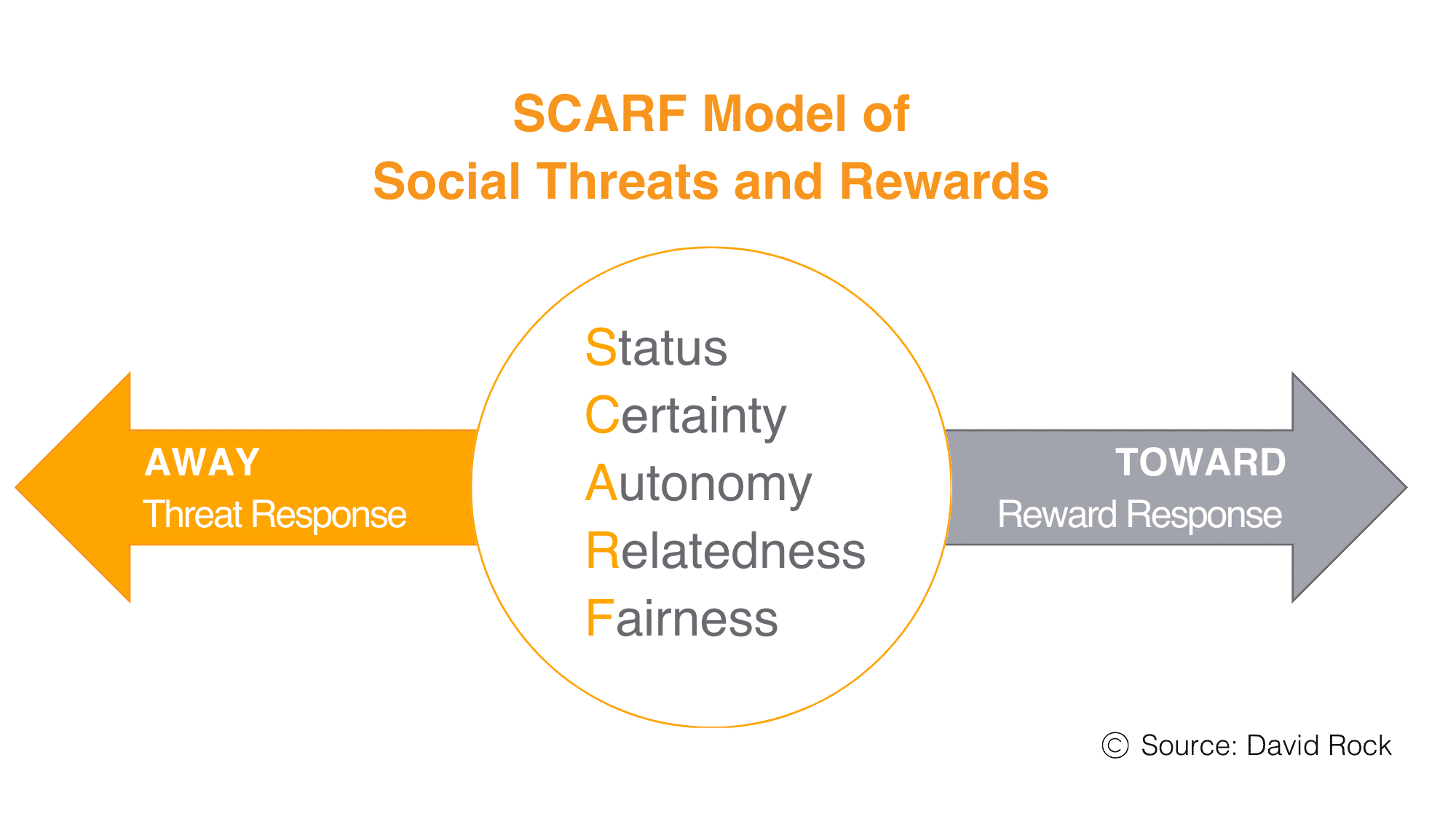
To use the SCARF model most effectively, it’s not enough to know the five domains—you also need to understand the individual needs and values of the people around you. Everyone experiences these domains differently.
Before you act, pause and ask yourself:
- What might this person see as a threat right now?
- What kind of reward would they most value in this moment?
Be mindful of your own bias, you may value one domain more than another, but that doesn’t mean others do. A leader who values autonomy may unconsciously assume others want freedom, when in fact they may crave certainty or relatedness. Using the SCARF model effectively requires curiosity, empathy, and perspective-taking.
Here’s how each domain might show up in practice:
Status
Our sense of importance or worth relative to others
Common Triggers:
- Dismissive tone or public correction
- Lack of recognition or visibility
- Being passed over for promotion
- Being overshadowed in group discussions
- Having your expertise publicly challenged
Ways to Meet This Need:
- Offer genuine, specific praise
- Involve people in stretch projects or decision-making
- Deliver feedback privately and constructively
- Support professional growth and confidence-building
- Consider eustress vs distress when assigning responsibility
Certainty
Our ability to predict what’s coming or understand expectations
Common Triggers:
- Vague or indirect communication
- Unclear expectations, roles and priorities
- Unannounced changes or constantly shifting priorities
- Incomplete updates or lack of follow-up/follow through on them
- Economical uncertainty or Industry wide changes (hello AI!)
Ways to Meet This Need:
- Communicate early and consistently—even when information is limited
- Break down complexity into manageable steps
- Clarify expectations, deadlines, and success measures
- Establish regular rhythms (e.g. check-ins, updates) to build predictability
- Coach your team to build resilience through uncertainty
Autonomy
Our sense of control and choice over what happens
Common Triggers:
- Micromanagement or rigid direction
- Exclusion from decisions that affect one’s work
- Limited ability to try new approaches
- Limited learning and development opportunities
- Overly complex / hierarchical approval processes
Ways to Meet This Need:
- Delegate responsibility, not just tasks
- Invite input and allow choice where possible
- Encourage experimentation and self-led problem solving
- Ask how they’d like to approach tasks or challenges
- Show trust by stepping back, not just checking in
Relatedness
Our sense of connection, inclusion, and trust
Common Triggers:
- Feeling excluded or left out
- In-groups or cliques
- Uneven attention from leadership
- Being treated as a number rather than a person (no interest in the human behind the role)
- A sense that my team doesn’t have my back
Ways to Meet This Need:
- Create space for informal connection (e.g. team rituals, peer check-ins)
- Ensure inclusion in discussions and events
- Check in regularly—especially with quiet or independent team members
- Build team culture around psychological safety and mutual support
- Acknowledge personal experiences and team milestones
Fairness
Our perception that rules, treatment, and outcomes are just and equitable
Common Triggers:
- Perceived favouritism or bias
- Hidden decision-making processes
- Inconsistent expectations
- Perceived inequity in distribution of workload/responsibility
Ways to Meet This Need:
- Be open about your decision-making rationale (within the bounds of confidentiality)
- Collaborate on team agreements and behavioural norms
- Apply expectations and consequences consistently
- Invite feedback on fairness and act on it
- Set clear objectives and revisit them regularly
Leadership Application
As leaders, our job isn’t to eliminate threat responses completely, that is impossible. But we can recognise when someone is triggered, understand which of these five needs might be affected, and respond in a way that helps reduce threat and restore psychological safety.
When the survival brain takes over, the thinking brain temporarily shuts down. In those moments, logic, reasoning, and emotional regulation are out of reach. By identifying the unmet need and responding with empathy and intention, we create the conditions for the thinking brain to re-engage, allowing others (and ourselves) to respond rather than react.

Reflective Questions
Please take some time to answer the questions below. The power of self-reflection lies in your willingness to be honest and vulnerable. The more openly you engage, the more insight and growth you’ll unlock.
- Which of the SCARF needs are most important to you and why? Rank each in order of importance.
- Think of a recent situation where you felt triggered. Why were you triggered? Which SCARF need does it relate to?
- Think of a recent situation when someone else was triggered. Why were they triggered? Which SCARF need does it relate to?
- Unsure of your social motivators? Complete this free assessment to learn more about yourself.