

Does happiness = success
OR
Does success = happiness?
We become more successful when we are happier and in a more positive mood state. For example, a seminal study conducted in 1991 found that doctors, when put in a mildly positive mood before making a diagnosis show almost three times more intelligence and creativity than doctors in a neutral state, and they make an accurate diagnosis 19% faster.
Isen, A., Rosenzweig, A., & Young, M. (1991). The Influence of Positive Affect on Clinical Problem Solving. Medical Decision Making, 11(3), 221–227.
As you can see from this foundational study and the sample of research described further below, hundreds of studies conducted on thousands of people worldwide consistently show that happiness leads to success, not the other way around.
Watch this four-minute explainer video to learn about happiness and its value in optimal performance.

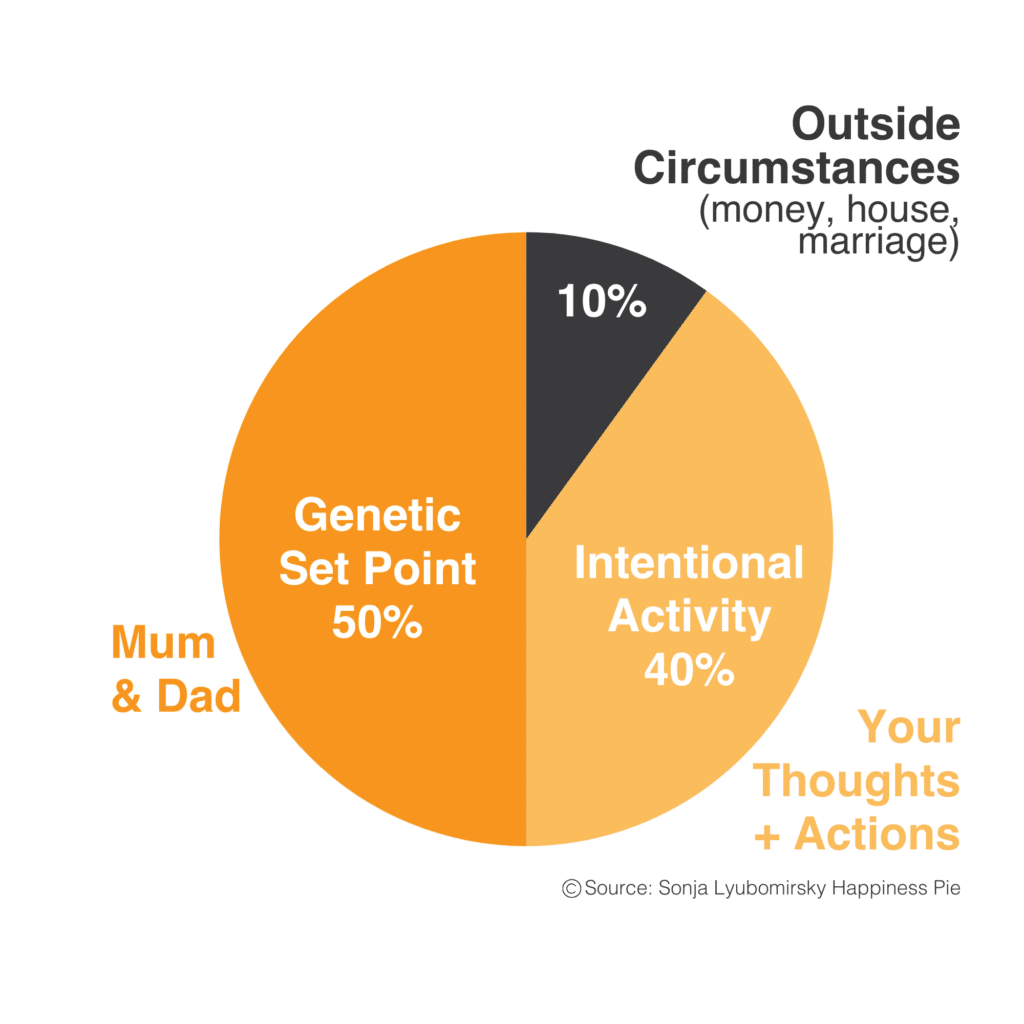
The “Happiness Pie” is a concept introduced by Sonja Lyubomirsky in her book The How of Happiness to illustrate the factors influencing individual happiness. It suggests that happiness is a combination of genetics, life circumstances, and intentional activities. Specifically, it proposes that approximately 50% of the variance in our happiness is determined by our genes, 10% by life circumstances, and 40% by intentional activities. This model is based on research by Lyubomirsky and her colleagues, Kennon M. Sheldon, and David Schkade.
Explanation of the Pie Chart
Genetics (50%):
Fascinatingly we inherit a degree of happiness from our biological parents. Picture happiness levels on a scale of 1-10. Some of are just unlucky and born with a 2 as our set point (default happiness level).
Life Circumstances (10%):
This refers to the things that happen TO us. I.e. whether we meet our dream partner, whether someone we love passes away, whether we are born in a warn torn economically unstable country etc. We have a significant tendency to overestimate how happy these things will make us and often get stuck in the trap of “waiting to be happy”. I.e. I’ll be happy when… But the truth is that it doesn’t affect our happiness by much, and then we revert to our biological set point.
Intentional Activities (40%):
This is the exciting bit. The component within our control. It refers to refers to the behaviours, attitudes, and actions individuals take to influence their happiness. Lyubomirsky’s research suggests there are 12 scientifically proven specific activities that can boost happiness levels.
Fostering Positive Emotion – 12 Intentional Activities
Express gratitude
Regularly acknowledging what you’re thankful for helps shift focus away from what’s lacking or stressful. It trains your brain to notice the good, boosting mood and resilience. This is covered in greater detail later.
Cultivate optimism
Optimism isn’t about ignoring problems—it’s about believing challenges are temporary and solvable. Optimistic leaders inspire hope, creativity, and motivation in others.
Avoid overthinking or comparing
Rumination and constant comparison drain mental energy and fuel dissatisfaction. Focus on your own progress and values, not someone else’s highlight reel.
Practice acts of kindness
Helping others triggers the release of feel-good chemicals like dopamine and oxytocin. Kindness strengthens social bonds and improves both mood and morale.
Nurture healthy relationships
Strong, supportive relationships are key to emotional wellbeing. Invest time in people who energise you, and build trust and psychological safety at work.
Develop effective coping strategies
Life throws curveballs. Resilient people have go-to strategies—like mindfulness, reframing, or movement—to help them recover and reset.
Learn to forgive
Holding onto resentment prolongs stress. Forgiveness doesn’t excuse poor behaviour—it releases you from the emotional burden, freeing up energy for growth. This is explored in more detail later.
Do more truly engaging activities
Engagement happens when you’re fully immersed in something meaningful. Seek out “flow” activities that challenge you just enough to keep you focused and energised.
Savour life’s joys
Pause to fully enjoy the little things—sunlight on your face, a warm drink, a shared laugh. Savouring amplifies the emotional impact of positive moments. And positive emotions drive performance.
Commit to your goals
Purposeful goals give life direction and meaning. Progress—even small steps—boosts confidence and a sense of accomplishment. It should be noted that setting goals, without commitment does the reverse to your wellbeing.
Practice religion or spirituality
For many, spiritual or religious practices provide comfort, connection, and a broader sense of purpose—all of which support emotional stability and hope.
Take care of your body
Movement, nutrition, hydration, and sleep are the foundation for mental clarity and emotional strength. A healthy body creates the conditions for a healthy mind.
Research supporting the power of positive emotions
In a meta-analysis of more than 100 organisational studies, employees who were consistently happier were found to be 12% more productive, with emotional well-being predicting performance outcomes more strongly than hours worked or other incentives.
Veenhoven, R., & Burger, M. J. (2025). Happiness and productivity: A research synthesis. Management Review Quarterly.
Pilot testing of an organisational happiness questionnaire found that teams with higher happiness scores showed 25–30% greater peer cooperation and reported 20% fewer interpersonal conflicts, confirming that emotional positivity enhances productivity and team synergy.
Apostol, E., Tallungan, J. R., & Vadil, C. (2024). Proposed Development and Validation of an Organizational Happiness Questionnaire. SSRN.
In virtual teams across four companies, leaders who emphasised positive emotional connection (via regular check-ins, praise, and fostering psychological safety) saw team retention improve by 18% and project delivery timelines improve by up to 22%, illustrating happiness as a factor in performance and continuity.
Foley, A. (2024). Strategies for Leading Successful Virtual Teams.
Among Nigerian SMEs, companies with a proactive culture and emotionally empowering leadership reported a 30–35% increase in quarterly profits and a 40% rise in employee-driven innovation proposals, showing clear economic benefits linked to emotional positivity.
Emmanuella, C. (2025). Impact of Proactive Orientation on the Performance of SMEs in Delta State. Journal of Behavioral Economics, Finance, and Management Innovation.
In organisations undergoing structural change, emotionally supportive practices like transparent communication and team celebration were linked to 60% fewer failed change efforts and a 25% improvement in employee participation during transformation rollouts.
DeJesus, I. (2024). Strategies for Implementing Organizational Change in the Construction Industry.
A case-based study showed that integrating employee well-being programs saw 22% increase in client satisfaction scores, a 17% reduction in staff turnover, and enhanced financial viability over two years, demonstrating a ripple effect from internal happiness to external success.
Meola, C., Grant, J., & Miller, J. (2025). The Trickle-Down Effect: How Does Research Really Help? HHRF.
It turns out that our brains are literally hardwired to perform at their best not when they are negative or neutral, but when they are slightly positive. The problem is that the average academic journal is not read by many people, so this valuable information is still not widely known.

Reflective Questions
Take a moment to reflect on your current habits and emotional wellbeing. Consider the 12 intentional activities that support happiness and resilience.
- Which intentional activities do you already practice consistently or feel come naturally to you?
- Which activities do you tend to overlook or not prioritise in your daily life?
- Which of these would be most valuable for you to intentionally do more of—either for your own wellbeing or your impact as a leader?
- Which of these strategies would be benefical to introduce into your regular leadership practice?
Write down your reflections and identify one small action you could take this week to build more positive emotion in your day-to-day life.
Happiness is not the belief that we don’t need to change; it is the realisation that we can. – Shawn Achor, Researcher and Author of The Happiness Advantage.
End of module. We look forward to seeing you at your next coaching call.