

The Four Steps of Emotional Intelligence
“Emotional Intelligence (EI) is a key measure of leadership effectiveness. EI helps people communicate effectively, make good decisions, manage stress, and conflict. It enables people to engage, instil confidence in and influence others, and respond sensitively even when challenged.” – Goleman, D. (1998). Working with Emotional Intelligence. Bantam Books.
Simply put, EI equips leaders to navigate the human side of their work with intention and impact.
Here is a 3.5-minute video explaining the role of EI in the workplace.

Emotional Intelligence: Still key to organisational success over 30 years later
Since its emergence in leadership research, emotional intelligence (EI) remains a driver of organisational and financial success. The evidence continues to build across industries, reinforcing that EI is not just a “nice-to-have”, it’s a vital performance enhancer. Recent research highlights how emotionally intelligent leadership continues to contribute to measurable outcomes:
Sales & Client Services
Sales professionals with higher EI, particularly in ambiguity tolerance and self-regulation, achieved 21% higher sales conversion rates and significantly improved customer satisfaction.
Mulki & Kamath (2025), International Journal of Bank Marketing
Tourism & Hospitality
Emotionally intelligent managers led teams that generated up to 19% higher revenue in service divisions over 12 months, driven by enhanced morale and guest satisfaction.
Sousa, Peres & Bacalhau (2025), Handbook of Organizational Psychology and Behavioral Strategy
Social Entrepreneurship
Founders with high emotional intelligence secured 20–25% stronger funding outcomes and scaled more quickly, highlighting EI’s role in building trust, alignment, and stakeholder engagement.
Busari (2025), The Role of Emotional Intelligence in Social Entrepreneurship
In today’s high-pressure, rapidly evolving environments, EI is just as relevant, if not more so than when it was first identified. It remains a core capability for effective leadership, sustainable business outcomes, and long-term impact.
Four Steps of Emotional Intelligence
An emotionally intelligent person demonstrates strength across four key areas. These components form the foundation of self-awareness, interpersonal effectiveness, and resilient leadership.
Label
The ability to accurately identify your own emotions and those of others, as they arise in the moment.
Understand
The ability to recognise the cause and complexity of emotions. Why we (or others) feel the way we do.
Use
The skill of incorporating emotional insight to support outcomes. Crafting a plan to help someone process emotion, reduce resistance, or positively influence the emotional climate.
Action
The ability to respond constructively to emotion, such as regulating your own feelings, supporting others to manage theirs, initiating a conversation, or asking a timely, thoughtful question.
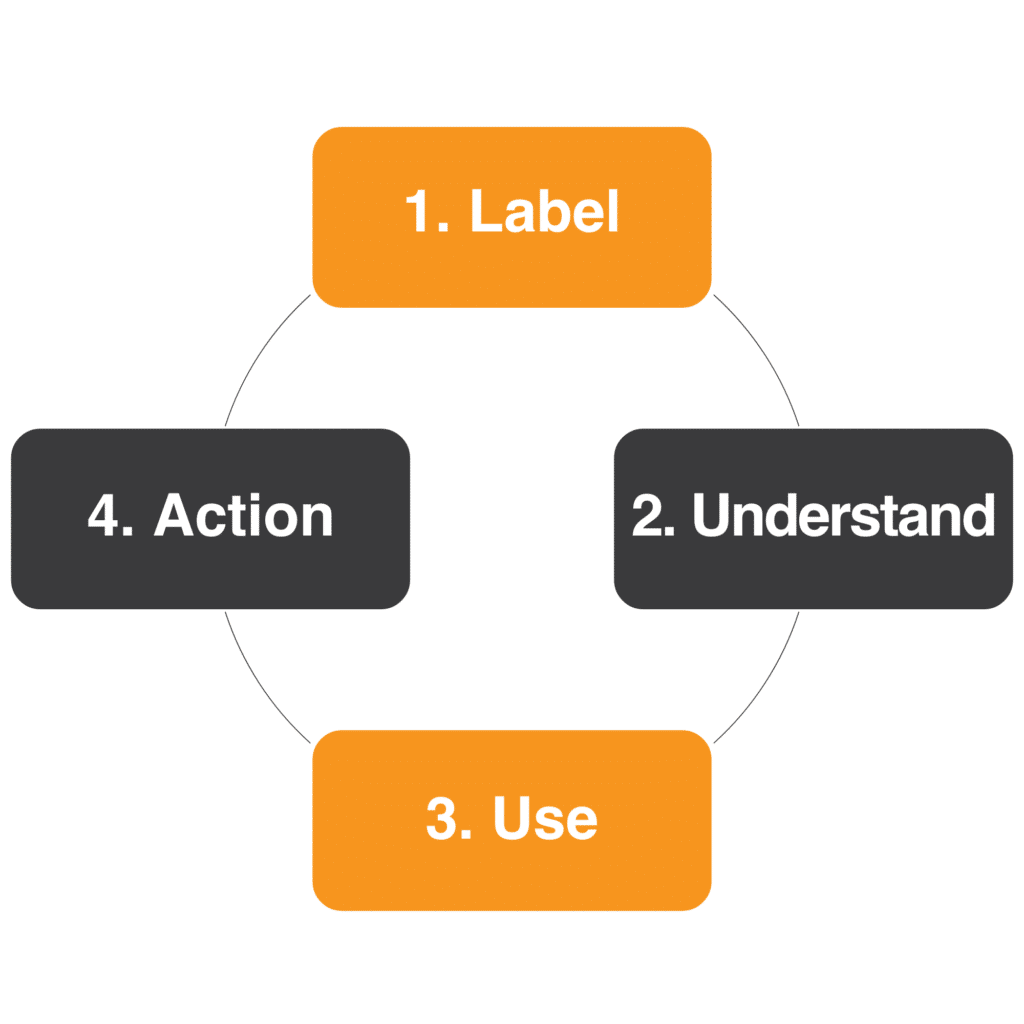
An Illustrated Example
To bring the ACP Four-Step Model of EI to life, let’s look at how it applies in two common situations. One in everyday life and one in the workplace. These examples show how noticing and working with emotion in real time can help us respond with intention, build stronger relationships, and prevent or reduce unhelpful conflict.
In Life
You’re having dinner with your partner, and they seem unusually quiet, tense and distracted.
Label
You notice their jaw is clenched and their tone is short. You identify that they may be feeling irritated or stressed.
Understand
You recall they had a tough meeting earlier in the day and suspect that lingering stress may be the root cause.
Use
Instead of reacting defensively, you adjust your tone and body language to be softer and more open, creating space for them to process their feelings.
Action
You gently ask, “Rough day?” or “Do you want to talk about what’s on your mind?”—offering support without pressure and helping them feel seen and safe to share.
At Work
You introduce a new process, and an engaged team member seems resistant and withdrawn.
Label
You notice signs of frustration and discomfort—closed body language, curt responses.
Understand
You recall that this team member values autonomy and efficiency. The new process might feel like micromanagement or unnecessary steps.
Use
You approach them with empathy and acknowledge the change might feel disruptive. You validate their perspective and communicate the purpose behind the change in a way that connects to their values.
Action
You say, “I can see this might feel like a big shift. Would it help if we explored ways to streamline this process together or adapt it for your workflow?”—inviting collaboration and reducing resistance.
Emotional intelligence isn’t about suppressing or avoiding emotions, it’s about recognising them, making sense of them, and using that insight to respond thoughtfully.
In the next topic, we’ll explore how to identify emotions more accurately in real time by recognising physiological markers and micro expressions—key signals that help us label emotions more effectively and engage with others with greater empathy and precision.

Reflective Questions
Please take some time to answer the questions below. The power of self-reflection lies in your willingness to be honest and vulnerable. The more openly you engage, the more insight and growth you’ll unlock.
- How frequently have you been paying attention to emotions lately?
- What is your knee jerk reaction when you realise someone is feeling a negative emotion?
- How comfortable are you in labeling and supporting other people to process these emotions when you notice them?
- How might paying attention to these emotions enhance your leadership?
- Are there any ongoing issues that may be overcome more efficiently by validating emotional objections?