

Contrary to popular belief, conflict is ESSENTIAL to long-term organisational success…
Most of the time, effective conflict is not actually about proving who’s right. Most often, it is about finding a way forward that supports a partnership, team, or organisation to achieve the best possible outcome. When navigated well, it becomes a catalyst for growth, innovation, and trust. Effective conflict requires flexibility and the ability to pivot depending on the situation at hand.
Conflict often carries a negative connotation, but not all conflict is harmful. The kind of conflict most people imagine (the shouting match, the passive aggressive tension, the emotional drain) isn’t what productive conflict is all about. All these characteristics are signs of unhealthy conflict.
You may be thinking… “Well, that’s obvious…”
But a less recognised characteristic of unhealthy conflict, and one that is sometimes even viewed positively, is avoidance.
On the surface, it can look like calm, maturity, or professionalism. In reality, an avoidance default is what we call a silent killer. It’s the quiet but dangerous symptom of an unhealthy conflict culture. Avoidance can arguably be more damaging that the other characteristics because it’s subtle, and therefore, prolific in leadership, teams, and organisations.
There are certainly times when stepping back is appropriate, like when the issue genuinely isn’t yours to resolve. But when avoidance becomes a habit or a way to mask discomfort, it creates fertile ground for unresolved tension. Left unchecked, this festers and erodes trust by damaging psychological safety.
A lack of trust weakens cohesion, and stalls innovation by limiting the flow of honest dialogue needed for idea generation and evolution (which we discuss in more detail in the next topic).
So, if avoiding conflict isn’t the answer…
What is healthy conflict?
Healthy conflict refers to open, respectful, and purposeful disagreement to generate better solutions, strengthen relationships, or improve performance by challenging ideas rather than people .
Rather than being disruptive, healthy conflict fosters:
This sounds wonderful in theory, but how do we work toward achieving this in reality?
In leadership, negotiation and conflict are rarely straightforward. It involves competing priorities, differing values, and underlying power dynamics that can make even simple conversations complex. Whether you’re managing tensions within a team, advocating for resources, or navigating cross-functional disagreements, it’s essential to understand how to balance assertiveness with empathy, and influence with integrity.
Knowing how to respond constructively in the face of these tensions is a critical leadership skill that requires self-awareness, emotional regulation, and strategic decision-making. The Thomas-Kilmann Conflict Model offers a practical framework to help leaders do just that.
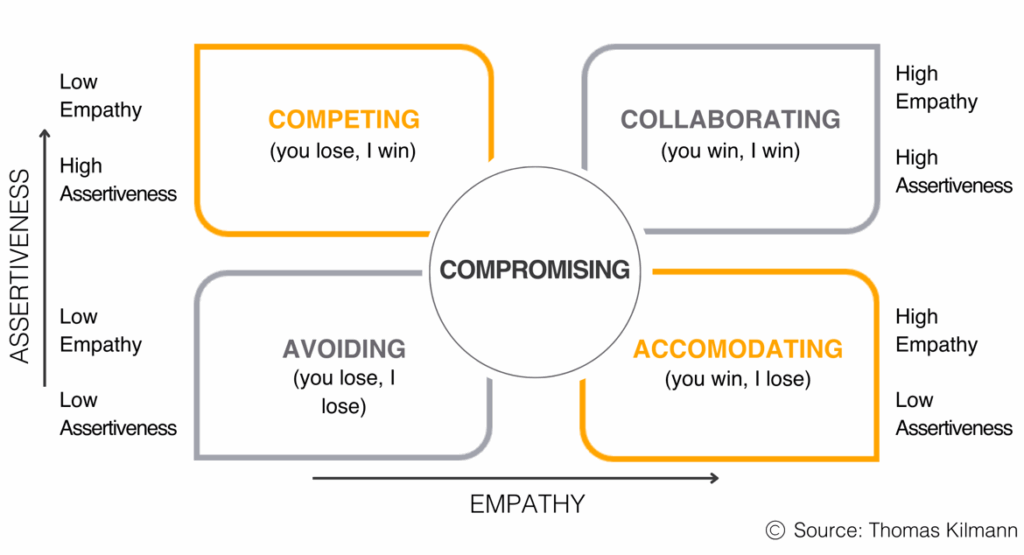
Developed by psychologists Kenneth Thomas and Ralph Kilmann, it outlines five distinct approaches to conflict, each shaped by how much we prioritise our own needs versus the needs of others. By understanding and applying these styles intentionally, leaders can better navigate high-stakes conversations, resolve disagreements productively, and build stronger, more resilient relationships.
Each style is based on two key dimensions:
By applying these dimensions intentionally and strategically, we can choose the most effective style for each conversation we’re navigating.
Watch this 5-minute video to understand more about the Thomas-Kilmman conflict model:

The Five Styles of Conflict Resolution
Avoiding
Low assertiveness / Low cooperativeness
Avoiding means stepping away from a conflict rather than addressing it. Sometimes, this is entirely appropriate. Perhaps the issue isn’t yours to manage, the stakes are low, or the timing isn’t right. For instance, if you overhear a couple arguing at the next table in a restaurant, it’s not your place to intervene.
The Cost of Avoiding
Avoiding becomes problematic when it’s used to dodge responsibility or discomfort. It’s tempting to rationalise avoidance by saying “It’s not my place,” when in reality, it probably is.
Avoidance in the workplace can seem like the ‘peaceful’ choice, but if overused, can lead to:
Competing
High assertiveness / Low cooperativeness
This style is about standing your ground to achieve your desired outcome, often with limited concern for the other party’s needs. It’s best used when the stakes are high and the relationship is not critical. For example, when negotiating a car price with a salesperson.
In leadership, where relationships matter, there are times when a firm, uncompromising stance is necessary. For instance, enforcing a non-negotiable safety protocol. However, because this style can create defensiveness, it must be used intentionally. Repairing the relationship afterwards, by acknowledging the impact and reaffirming trust, is essential.
The Cost of Competing
While competing can be useful, inappropriate use of this style can lead to:
Accommodating
Low assertiveness / High cooperativeness
Accommodating involves prioritising the other person’s needs over your own. It can be useful in preserving relationships, showing goodwill, or de-escalating tension in the short term. For example, as a new leader inheriting a disengaged team member, you might accommodate some early requests to signal care and build rapport.
The Cost of Accommodating
Accommodating can build goodwill when used well, however when used too often, it can ironically breed resentment and lead to an imbalance in working relationships. It’s important to choose this style consciously, as habitual use often results in:
Compromise
Moderate assertiveness / Moderate cooperativeness
Often seen as a fair approach, compromise requires both parties to give something up to reach a mutually acceptable solution. It’s useful when time is limited or when both sides have equal power to build goodwill and maintain momentum. For example, agreeing to split project resources between two departments to meet a collective deadline, even if it’s not ideal for either.
The Cost of Compromising
Despite being commonly called “win-win,” compromise is actually lose-lose to some extent, as no one walks away with their ideal outcome. While compromise can keep things moving, relying on it too often can lead to:
Collaborating
High assertiveness / High cooperativeness
Collaboration is the gold standard for conflict resolution. It involves working together to find a solution that fully satisfies both parties’ needs. It requires mutual respect, emotional regulation, active listening and open, objective dialogue. For example, two department heads with competing priorities work together to design a strategy that addresses both their goals without sacrificing either.
The Cost of Collaborating (yes, even the gold standard has a cost!)
Collaboration takes time, emotional effort, and a high level of trust. It’s essential for complex, high-stakes issues in long-term relationships but not always practical for minor decisions. Overusing it can result in:
A Leader’s Role in Cultivating Healthy Conflict
- Normalise conflict as part of healthy collaboration
Reframe conflict as a necessary and even productive part of teamwork. When leaders treat disagreement as a sign of engagement—not dysfunction—they give teams permission to speak up and explore diverse perspectives.
2. Model calm, curious responses to disagreement
Leaders set the tone for how conflict is handled. Responding with emotional regulation and genuine curiosity—rather than defensiveness—encourages others to do the same and builds psychological safety.
3. Create safe environments for challenge and feedback
Proactively foster a culture where respectful disagreement is welcomed. This means inviting input, valuing dissenting views, and ensuring that team members feel heard, even when their ideas aren’t adopted.
4. Intervene when needed to keep conflict constructive, not personal
Step in when conflict risks becoming harmful or off-track. Leaders should guide conversations back to shared goals, ensure all voices are respected, and redirect unproductive behaviour to protect the health of the team dynamic.
Case Example: Healthy vs Unhealthy Conflict in a Work Environment
A product development team at a mid-sized tech company is preparing for a critical pitch to the executive board. Tensions rise when the Head of Product, Emily, and the Marketing Lead, Sam, strongly disagree on the go-to-market strategy.
Unhealthy Conflict Response
- The disagreement escalates over time and becomes personal, with both parties avoiding conflict by escalating privately to the Director rather than working through the issue together.
- Team meetings grow tense and guarded, as others begin to take sides or avoid weighing in altogether.
- Little effort is made to understand the broader organisational context or each other’s constraints.
Outcome
The Director, feeling pressure to prevent further division, opts for a compromise. A partial feature update paired with a limited marketing rollout. But the outcome is a watered-down strategy that satisfies no one. The product lacks the polish needed to impress users, the marketing campaign feels misaligned, and the team is left frustrated. Most significantly, internal trust is weakened.
Healthy Conflict Response
- The Director calls a meeting to explore and surface the underlying needs driving each leader’s position.
- Together, they map out the situation along the assertiveness vs cooperativeness dimensions, helping both parties see that their conflict stems from legitimate but competing priorities.
- Rather than pushing for a quick compromise, the team engages in a collaborative problem-solving session to identify creative options that meet both sets of needs
Outcome
They agree on a staggered release strategy. A soft launch proceeds on schedule to satisfy marketing deadlines and revenue goals, while the product team continues refining key features for a full feature rollout shortly after. This approach maintains momentum without sacrificing product quality.
Most importantly, when adopting an appropriate conflict approach, in addition to finding an optimal solution, both leaders feel heard and respected. The experience strengthens cross-functional trust, reinforces a culture of healthy conflict resolution, and sets a positive precedent for independent navigation of future disagreements with openness and collaboration.
Leadership Application
In learning to lead conflict resolution effectively, it is insightful to reflect on your ‘default’ conflict style. The one you tend to lean on most often, especially under pressure. This preference is often shaped by our personality traits, past experiences, and even early role models of conflict.
While it’s normal to have a style that feels most comfortable, it’s important not to rely on it as a one-size-fits-all approach. As we’ve explored, different situations call for different strategies. Effective leadership means being flexible and intentional when approaching conflict to ensure we are selecting the style that best fits the context, not just the one that feels familiar.
Exercise: Finding Your Default Style
Take a few moments to reflect on your typical responses to conflict, particularly when you’re under pressure, feeling emotional, or when the stakes are high. Then answer the following prompts honestly and without any judgement of yourself or your response.
Step 1: Reflect on a recent conflict
Think of a recent conflict (personal or professional). Briefly describe the situation using the prompts below to guide your thinking:
Step 2: Explore your response
Step 3: Identify the style
Looking at the five Thomas-Kilmann styles below, which one best reflects how you approached that situation?
| Avoiding | Stepping back, delaying, or staying silent |
| Competing | Standing firm, aiming to win |
| Accommodating | Yielding to the other person’s needs |
| Compromising | Meeting halfway, finding middle ground |
| Collaborating | Working together for a win-win outcome |
Step 4: Dig into the “why”
Step 5: Consider the pattern

Reflective Questions
Please take some time to answer the questions below. The power of self-reflection lies in your willingness to be honest and vulnerable. The more openly you engage, the more insight and growth you’ll unlock.
- Which style have I been using most recently? Was it fit for purpose?
- Where am I most comfortable on this model? Why?
- Where am I least comfortable on this model? Why?
- Thinking about an upcoming negotiation or discussion, which style will best set you up for success? What can you do to ensure you embody that style?