

“Coaching involves partnering with clients in a thought provoking and creative process that inspires people to maximize their personal and professional potential. Coaching aims to get to the ‘heart of the problem’; unpacking the thinking, emotions, beliefs or values that are contributing to that current challenge. This often enables clients to get un-stuck and regain forward momentum.”
– The International Coaching Federation (ICF)
The ACP Leader Coaching Philosophy
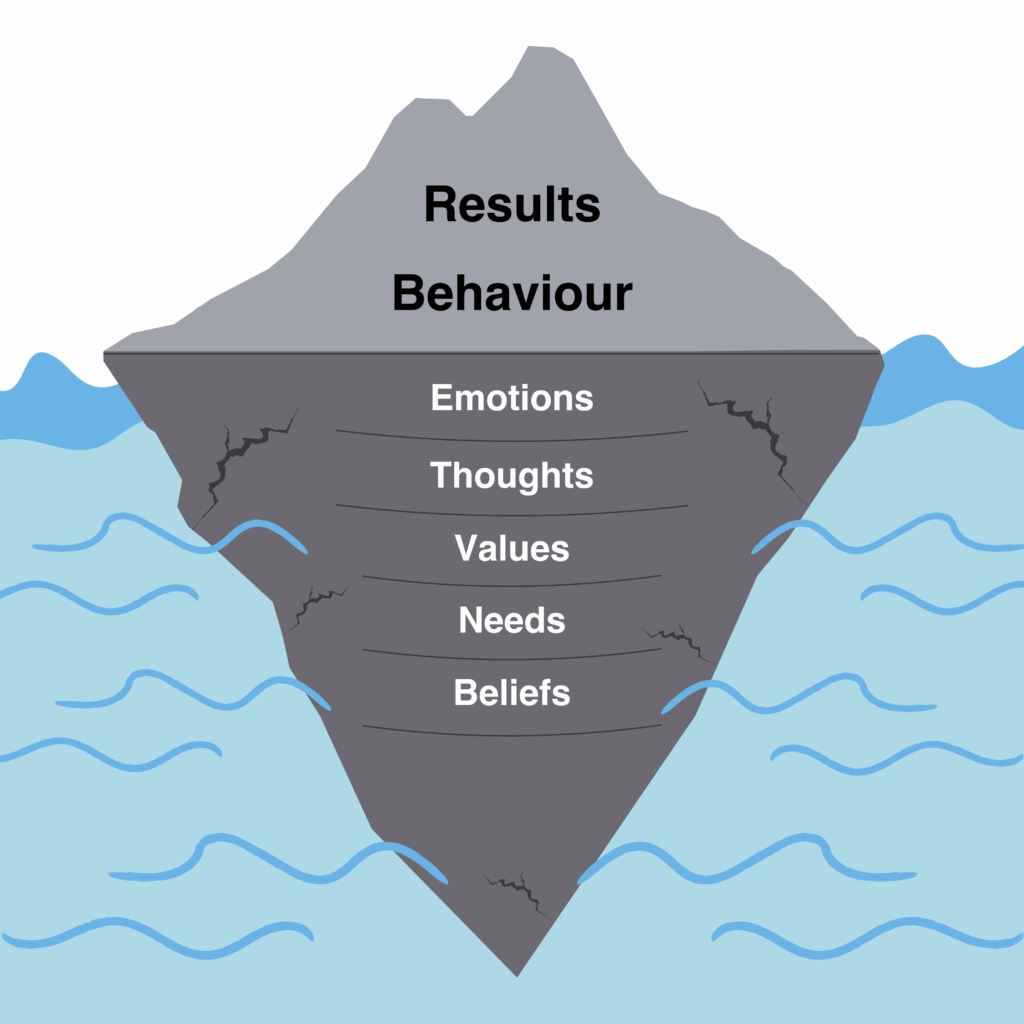
Roughly 10% of an iceberg floats above water, the other 90% lies hidden below the surface. Much like an iceberg, only a small portion of a person’s challenge is visible on the surface. In the same way as an iceberg, what we initially see in someone’s behaviour, such as missed deadlines, disengagement, or performance dips, often represents just a fraction of what’s really going on underneath those observable actions.
Beneath the surface there may be a complex web of limiting beliefs, mindset blocks, fears, values, assumptions, past experiences, or even unconscious habits. These deeper factors often shape the decisions people make and the observable behaviours they display.
If we want to support someone through transformational and sustainable change, surface-level problem-solving isn’t enough. As leaders, our role is to act as a coach by getting curious and creating a safe space that helps people explore what could be beneath the waterline.
It’s only by addressing the internal blockers below the surface that people can experience insight and unlock meaningful progress.
How is coaching unique?
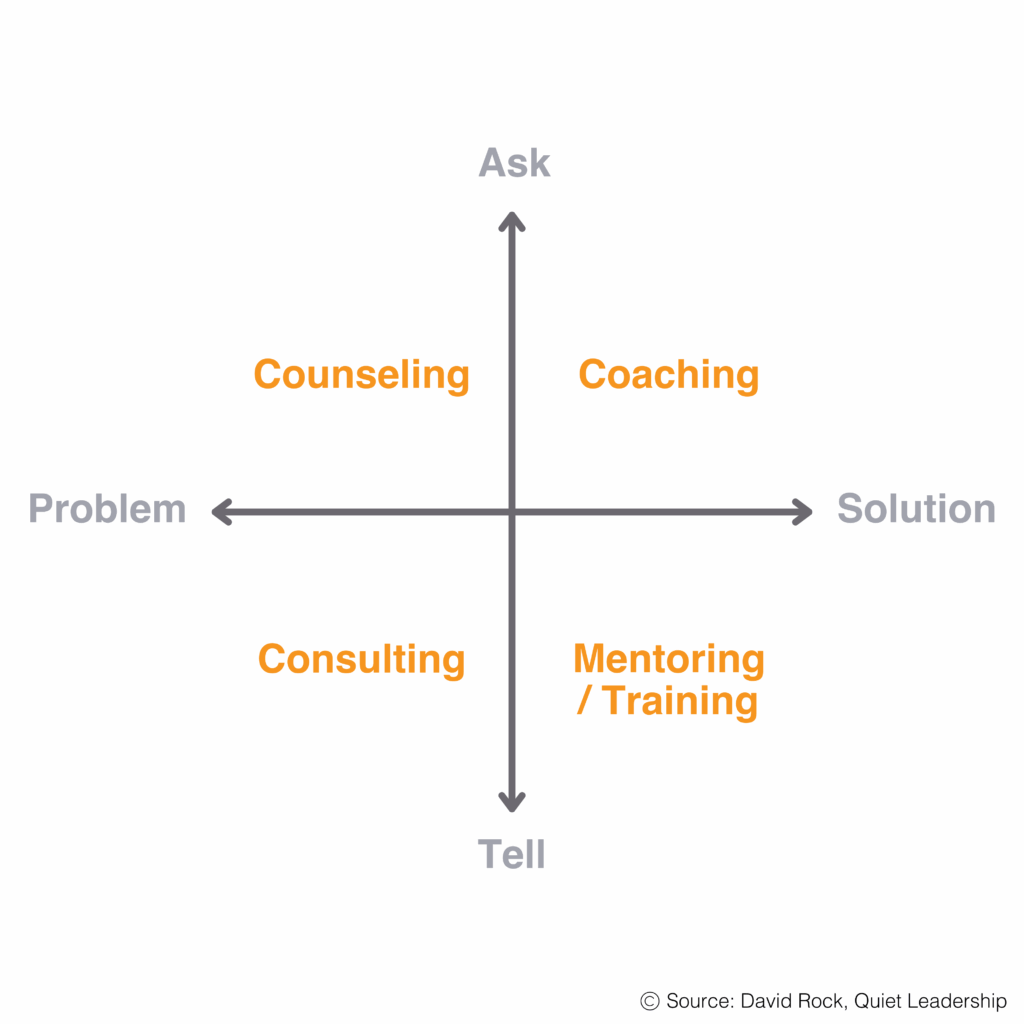
Coaching sets itself apart from teaching, consulting, and mentoring by recognising you as the expert in your own life. Rather than offering advice or solutions based on their own experience, a coach uses thought-provoking questions to stimulate self-reflection, helping you uncover your own answers. Coaching is a forward-focused, empowering process designed to help you generate your own insights and take meaningful action.
While coaching and counselling both honour the wisdom within the individual, coaching differs by maintaining a future-oriented focus. Counselling is often used to explore and process past events to gain understanding or healing, whereas coaching focuses on what comes next, supporting you to set goals, overcome obstacles, and move forward with clarity and confidence.
It’s important to note that counselling should always be provided by a qualified mental health professional, and in some workplace settings, it may be necessary or appropriate. While ACP does not offer counselling services, we are happy to refer you to one of our trusted clinical psychology partners if additional support is needed.
The ACP Coaching Model
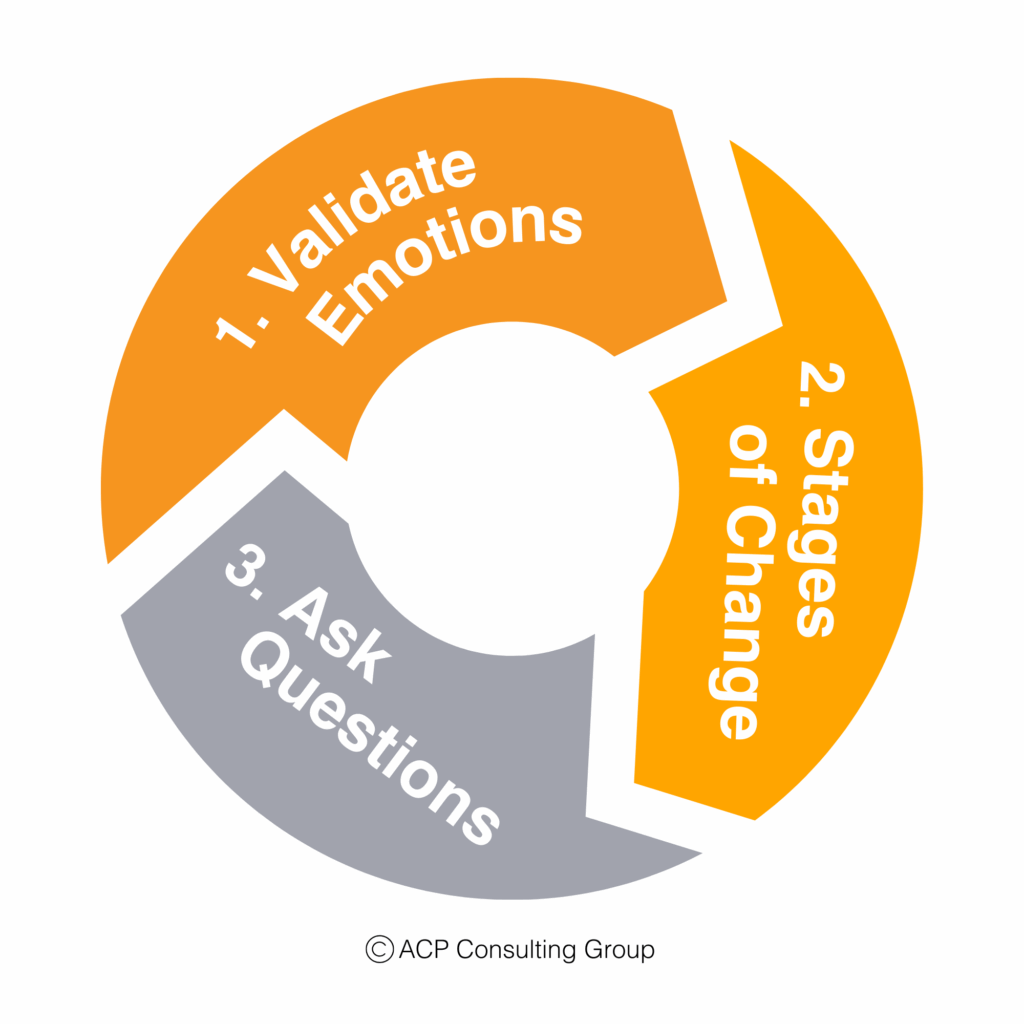
Watch this 2-minute video that explains the three steps we use when coaching.

Validation
Our ability to empathise with another person’s emotional experience and acknowledge their reality, while helping to remove the obstacles that may be holding them back. Effective validation fosters trust, psychological safety, and readiness for change.
See related content in: Topics on Primary Emotions and The Physiology of Emotions.
Stages of Change
A framework for identifying where someone is on their change journey, what they’ve already tried, what’s worked or not worked, and how motivated they are to move forward. Understanding this helps us tailor our leadership and support strategies effectively.
See related content in: Topics on Change and the Brain, and Stages of Change.
Questions
Strategic questioning is one of the coach’s most powerful tools. Well-crafted questions help uncover the coachee’s current stage of change, clarify goals, surface obstacles, and shift limiting frames. Context, timing, and tone are critical—ask the right question for where the person is right now.
Explored in the next Topic on Questions.
Go-To Coaching Questions
Having a go-to list of coaching questions is a valuable tool for any leader. It helps you stay present in the conversation, avoid the temptation to jump into problem-solving too quickly, and ensure your approach is intentional rather than reactive. Well-crafted questions create space for insight, challenge assumptions, and guide others toward their own solutions—making your conversations more impactful, even under pressure.
Use these open-ended questions to deepen reflection, promote ownership, and support forward momentum.
Listening Traps
Using questions without listening to their answer can be extremely counterproductive.
In our conversations, it’s easy to fall into common listening traps. These are patterns where we stop truly hearing the other person because we’re focused on solving the problem, offering advice, or planning our response. These traps are usually driven by good intentions and a natural desire to help, fix, or feel useful. But in doing so, we often miss the real intention, meaning, or essence of what the other person is trying to express.
Look at the list below and reflect on what your listening traps are. Ask yourself, “Why am I really listening right now?”

The Secret Ingredient of Active Listening
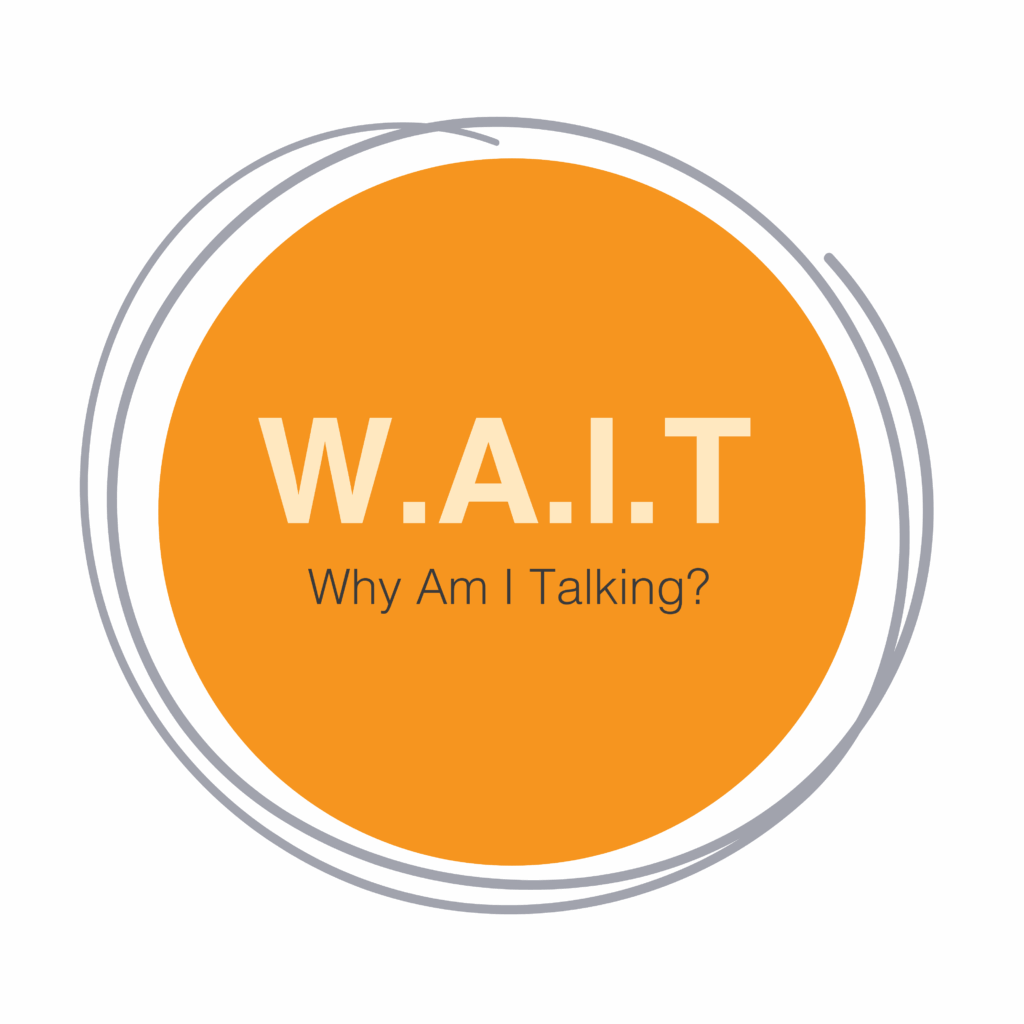
W.A.I.T: Why Am I Talking?
This simple but powerful question lies at the heart of active listening. Before during and after we speak, we should be continually reflecting and asking ourselves:
Am I talking right now to push my own agenda?
Am I trying to rescue them from their discomfort, rather than sitting with those feelings?
Am I speaking to position myself as the expert, rather than genuinely supporting their expertise in their growth journey?
True active listening requires more than silence, it requires genuine curiosity. It means letting go of the often very strong urge to fix, impress, or direct, and instead stay present with the other person’s experience. That’s where insight and transformation begin. To turn curiosity into meaningful insight, we must suspend judgement. That means letting go of criticism, assumptions, or “black-and-white” thinking (e.g. right/wrong, good/bad).
Instead of jumping to conclusions, we must choose to stay open to multiple perspectives, embrace complexity, and keep asking thoughtful questions. This openness creates space for deeper understanding and helps others explore their own thinking more fully.
Questions that promote curiosity (for the coach)
Use these questions to stay curious, set aside assumptions, and deepen your understanding of the person in front of you. They’re designed to open up and invite reflection, and help you truly listen, beyond just the words being said.

Reflective Questions
Please take some time to answer the questions below. The power of self-reflection lies in your willingness to be honest and vulnerable. The more openly you engage, the more insight and growth you’ll unlock.
Use the prompts below to explore how and where you can integrate more of a coaching approach into your leadership practice:
- Where in your current role do you have opportunities to use a coaching approach?
Think about where curiosity, questioning, or shared problem-solving might serve better than immediate instruction. - When do you find it most challenging to hold back from giving advice?
Consider situations where your experience makes it tempting to jump in quickly. What impact does this have? - What simple strategies can help you stay curious a little longer?
What reminders, habits, or questions could prompt you to listen more deeply and create space for others to think?
Further Reading
This module offers only a brief introduction to coaching. Coaching is a complex skill that involves a much broader set of tools and practices than we’ve covered here. If coaching is an area you’d like to explore further, consider exploring our Leadership Redefined Coaching Program or diving into one of the excellent books below:
The Coaching Habit – Michael Bungay Stanier
A practical, no-fluff guide to building coaching into everyday leadership conversations.
The Advice Trap – Michael Bungay Stanier
Challenges the urge to give advice too quickly and shows how to stay curious longer.
The Human Behind the Coach – Claire Pedrick & Lucia Baldelli
Explores the presence, mindset, and vulnerability needed to be an authentic and impactful coach.
Coach the Person, Not the Problem – Marcia Reynolds
Focuses on helping people uncover their own thinking rather than just solving surface-level issues.